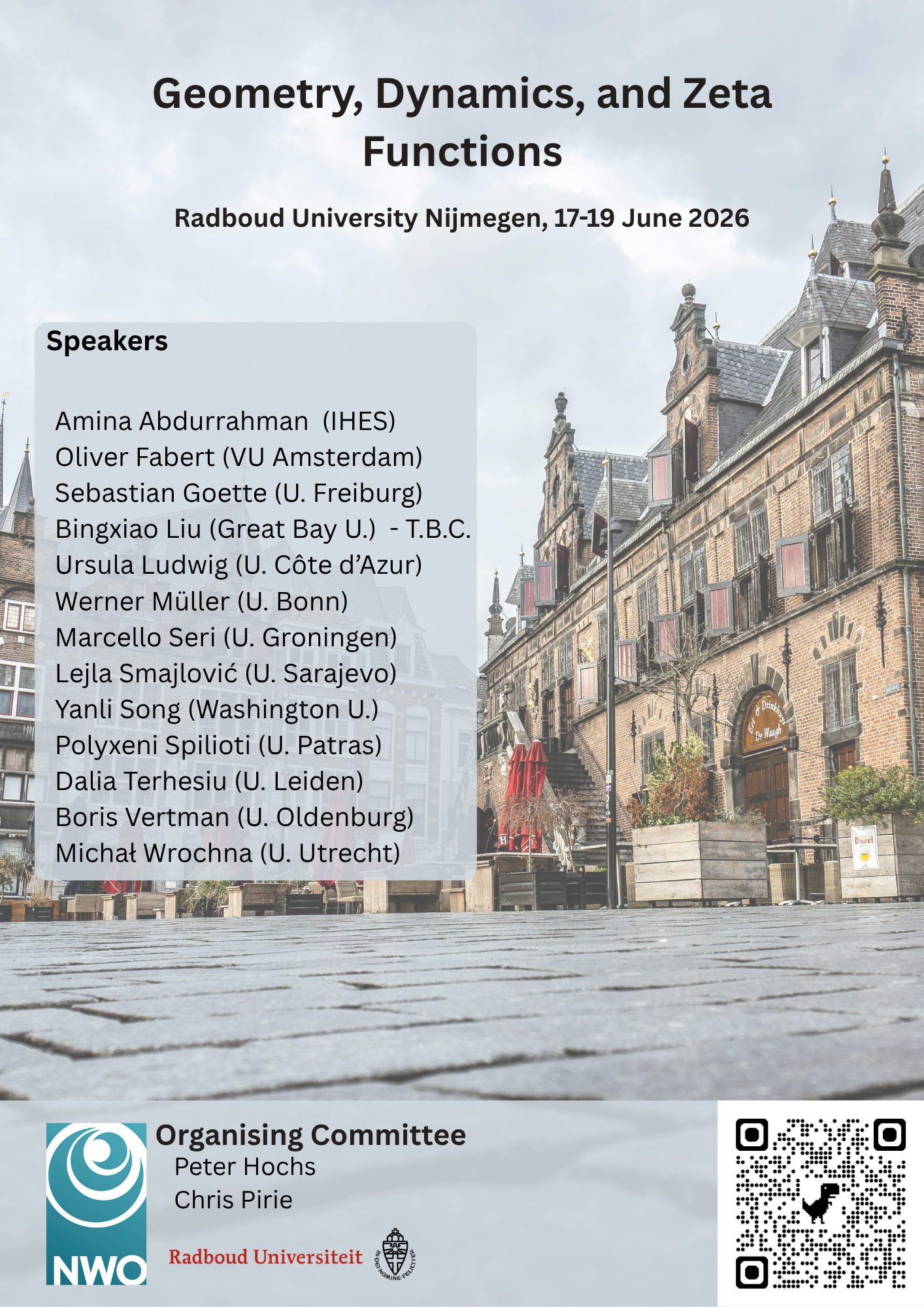
Geometry, Dynamics, and Zeta Functions

Europe/Amsterdam
Radboud University

Radboud University

Heyendaalseweg 135, 6525 AJ Nijmegen
Chris Pirie, Peter Hochs
Description

Dynamical systems, or flows, on geometric spaces play important roles in a wide range of areas inside and outside mathematics. For example, 

  • Hamiltonian flows on symplectic manifolds describe classical mechanics;
  • geodesic flows lie at the heart of Riemannian geometry and general relativity.

The interplay between such flows and the geometry and topology of the underlying spaces is of crucial importance. The geometric or topological structure of a space may determine properties of the possible flows on the space. Conversely, flows may be used to probe the geometry and topology of a space. 

A key tool is the use of dynamical zeta-functions, which encode information about a flow. For example, the Ruelle dynamical zeta-function 'counts' periodic orbits, and is linked to the topology of the underlying space via the Fried conjecture. 

There are several ways to approach the study of geometric dynamical systems and related zeta-functions. These include

  • the analytic approach, using microlocal analysis;
  • the group-theoretic approach, exploiting the symmetries of a given geometric space.

The goal of this meeting is to bring together leading and emerging researchers on the different aspects of geometric dynamical systems, and to allow them to combine their different perspectives to take the field further.

Participation is free, but registration is mandatory. The deadline for registration is 15 May 2026.

Speakers

Contributed PhD Talks


Warning

There are spam emails in circulation that ask for personal details in order to reserve/book hotel rooms for this conference. Do not respond to them or give them personal details. We will only ever contact you about this conference from email addresses ending in @ru.nl or @math.ru.nl.
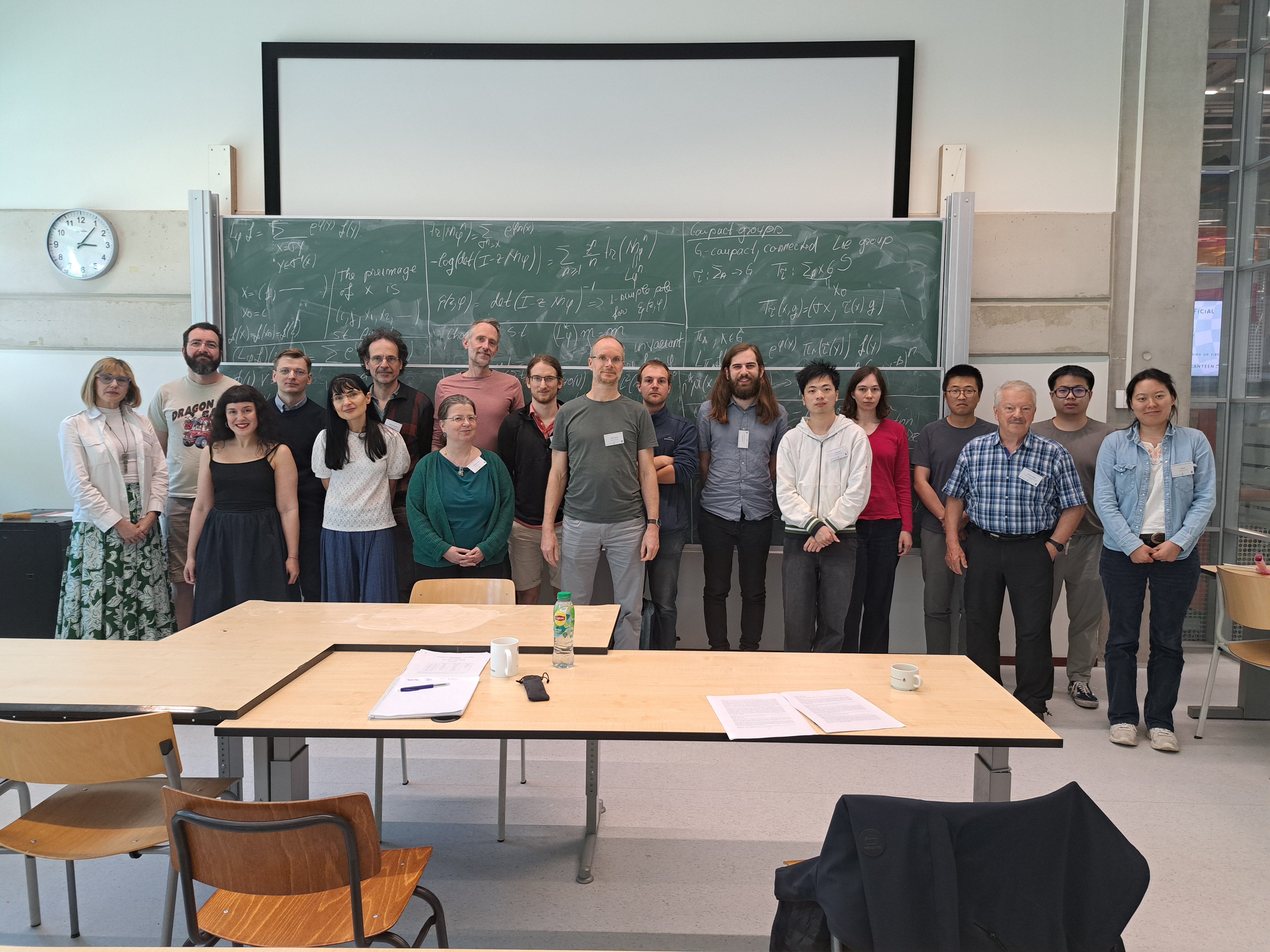


Participants
    • 9:00 AM 9:30 AM
      Welcome 30m
    • 9:30 AM 10:30 AM
      Müller: Approximation of L^2-Invariants of locally symmetric spaces of finite volume HG00.539

      HG00.539

      $L^2$-invariants are defined for the universal covering of a compact manifold as counterparts of classical invariants such as Betti numbers, the index of elliptic operators, or the analytic torsion. Their definition uses the group von Neumann algebra. They have important applications in topology and geometry. Of particular interest is the question if $L^2$-invariants can be approximated by the corresponding classical invariants for a sequence of coverings of finite degree converging in the Benjamini-Schramm sense to the universal covering. In this talk I will discuss this problem for locally symmetric spaces of finite volume and the analytic torsion. The basic tool is the Arthur-Selberg trace formula. If time permits I will also discuss some applications to the cohomology of arithmetic groups.

    • 10:30 AM 11:00 AM
      Coffee Break 30m
    • 11:00 AM 12:00 PM
      Spilioti: Determinants of twisted Laplacians and the twisted Selberg zeta function HG00.539

      HG00.539

      Let $X$ be a compact hyperbolic surface with finite order singularities and $X_1$ its unit tangent bundle. We consider the twisted Selberg zeta function  $Z(s;\rho)$ associated with a representation $\rho \colon \pi_1(X_1) \to \mathrm{GL}(V_\rho)$.

      In this talk, we will present recent results concerning a relation between the twisted Selberg zeta function  $Z(s;\rho)$  and the regularized determinant of the twisted Laplacian. The main tool we use is the Selberg trace formula. If $X$ has no finite order singularities, we obtain as a corollary a corresponding relation. This is joint work with Jay Jorgenson and Lejla Smajlović.

    • 12:00 PM 1:00 PM
      Lunch 1h
    • 1:00 PM 2:00 PM
      Vertman: Geometric microlocal analysis meets discrete geometry HG00.539

      HG00.539

      Melrose's geometric microlocal analysis involves the concept of blowing up submanifolds to resolve non-uniform operator kernel behaviour. This technique has been central to the analysis of singular spaces, but was previously disconnected from discrete geometry. We introduce a new framework that applies Melroses's blowup techniques to scaling limits of discrete surfaces to study the discrete heat kernel as the discretization mesh size goes to zero. This proves a full asymptotics of the determinant on discrete surfaces beyond the example of regular lattices that has been the best possible result so far.

    • 2:00 PM 3:00 PM
      Wrochna: Spectral zeta function densities on asymptotically Minkowski spaces HG00.539

      HG00.539

      I will discuss a microlocal analysis approach to local spectral zeta function densities on classes of pseudo-Riemannian manifolds including asymptotically Minkowski spaces. The poles are shown to be local geometric invariants, whereas renormalized trace densities provide a rigorous definition of physical quantities in Quantum Field Theory. A key role is played by the asymptotic dynamics arising from suitable spacetime compactifications. This is joint work with Nguyen Viet Dang and Andras Vasy, with ongoing work on extensions also by/with Ashkan Sadat Kyaee and Mikhail Molodyk.

    • 3:00 PM 3:30 PM
      Coffee break 30m
    • 3:30 PM 4:30 PM
      Song: Hecke Operator and Ruelle Dynamical Zeta Function HG00.539

      HG00.539

      The Ruelle zeta function is a way of organizing the closed geodesics of a compact locally symmetric space into a single dynamical object. In this talk, I will explain a version of this construction incorporating Hecke operators. Hecke operators are natural notions of symmetries of locally symmetric spaces, and define correspondences between every point and finitely many other points. In the classical setting, a closed geodesic returns to itself because of a deck transformation, or equivalently an element of the fundamental group. In the Hecke setting, we allow the return to happen through a Hecke correspondence. This leads to a new length spectrum: instead of only seeing whole multiples of the length of a primitive closed geodesic, we can see new return lengths, sometimes even fractional ones.

      The main part of the talk will focus on how this Hecke Ruelle zeta function is constructed and why its definition naturally involves certain multiplicities. These multiplicities record how many Hecke returns give the same geometric data, and how the corresponding periodic geodesic loci cover each other. I will then discuss two applications. The first is a Hecke prime geodesic theorem, which gives an asymptotic count of closed geodesics returning under a Hecke correspondence. The second is a Hecke version of Fried's conjecture, relating the special value of the Hecke Ruelle zeta function to a Hecke analogue of analytic torsion in the acyclic rank one case. Part of the talk is based on an ongoing joint work with Peter Hochs and Polyxeni Spilioti.

    • 4:30 PM 5:30 PM
      Discussion 1h
    • 9:30 AM 10:30 AM
      Abdurrahman: TBA HG00.539

      HG00.539

    • 10:30 AM 11:00 AM
      Coffee break 30m
    • 11:00 AM 12:00 PM
      Goette: nu-Invariants of Extra-Twisted Connected Sums HG00.539

      HG00.539

      There are nowadays different types of examples of compact Riemannian manifolds with holonomy group $\mathrm{G}_2$. One may ask if different constructions can lead to diffeomorphic $\mathrm{G}_2$-manifolds, and if so, whether their $\mathrm{G}_2$-metrics belong to different connected components of the corresponding moduli space. Crowley and Nordström's invariant nu and its analytic refinement are able to detect some of these connected components.

      After a short review of $\mathrm{G}_2$-geometry, we will compute the nu invariant for extra-twisted connected sums. This involves the computation of eta invariants using gluing formulas and adiabatic limits, which lead us to logarithms of special values of the Dedekind eta function at arguments in certain imaginary quadratic number fields. Finally, we see that many of the possible values of the nu invariant are attained by our examples.

    • 12:00 PM 1:00 PM
      Lunch 1h
    • 1:00 PM 2:00 PM
      Fabert: Multisymplectic Floer theory: from closed orbits to closed surfaces HG00.539

      HG00.539

      Hamiltonian Floer theory is a fundamental tool in symplectic geometry that is used to establish lower bounds for the number of closed Hamiltonian orbits. While geodesics are the basic examples of Hamiltonian orbits, minimal surfaces are the 2-dimensional generalizations of geodesics. We present a 2-dimensional generalization of Hamiltonian Floer theory that is fit for proving lower bounds for the number of closed minimal surfaces in K\"ahler manifolds as well as of closed solutions of more general nonlinear equilibrium problems. This is joint work with Ronen Brilleslijper.

    • 2:00 PM 3:00 PM
      Terhesiu: Some aspects of dynamical zeta functions for group extensions of dynamical systems HG00.539

      HG00.539

      In the first part of the talk, the main aspects of the theory of zeta functions for compact, non abelian, group extensions of dynamical systems (mostly shifts of finite type) will be recalled. In particular, the link between the poles of twisted zeta functions and probabilistic phenomena will be recalled. We state some results for some non compact, non abelian group extensions of dynamical systems and discuss open problems for twisted zeta functions in the non compact, non abelian case.

    • 3:00 PM 3:30 PM
      Coffee break 30m
    • 3:30 PM 4:00 PM
      Elzenaar: Hands-on cone deformations of hyperbolic manifolds HG00.539

      HG00.539

      Holonomy groups of complete hyperbolic structures on 3-manifolds are discrete subgroups of $\mathrm{PSL}(2,\mathbb{C})$. This means that the deformation space of complete hyperbolic structures can be embedded as an open subset of a representation variety. If multiple such deformation spaces live in the same character variety, how are they related to each other? One way to understand this is to deform the hyperbolic metric through incomplete metrics, either by hand or by an abstract harmonic theory due to Hodgson--Kerckhoff. As an application, we prove a conjecture of Lee and Sakuma, that there is a continuous path of hyperbolic cone 3-manifolds joining any hyperbolic 2-bridge knots to the boundary of a Teichmuller space, for knots that are highly twisted in a precise sense.

    • 4:00 PM 4:30 PM
      Straat: Periodic Orbits in Quantum Mechanics up to First Order in $\hbar$ HG00.539

      HG00.539

      In this talk, I will introduce my ongoing research on the existence of periodic orbits in first-order approximations to quantum mechanics. Our goal is to investigate how Floer theory can be applied to quantum physics. By adding a stochastic sector to the fields in our classical system, it becomes equivalent to Wigner-Weyl quantum mechanics up to first order in $\hbar$. The most famous example of such a model is stochastic electrodynamics (SED). We attempt to combine prior results in Floer theory (Fabert-Lamoree, 2023; Fabert, 2024) to find periodic solutions in the stochastic particle-field model.

    • 4:30 PM 5:30 PM
      Discussion 1h
    • 6:30 PM 8:30 PM
      Conference Dinner 2h
    • 9:30 AM 10:30 AM
      Ludwig: Torsion and refined torsion on singular spaces HG00.616

      HG00.616

      The comparison between analytic and topological torsion of a smooth compact manifold equipped with a unitary flat vector bundle, aka Cheeger-Müller theorem, is one of the most important comparison theorems in global analysis. Refined versions of both analytic and topological torsion on a smooth compact manifold have been amply studied as well.

      The aim of this talk is to present extensions of the Cheeger-Müller theorem for torsion as well as for refined torsion on singular spaces with conical singularities.

    • 10:30 AM 11:00 AM
      Coffee break 30m
    • 11:00 AM 12:00 PM
      Smajlović: Determinant of the weighted Laplacian for the sequence of asymptotically large compact Riemannian surfaces HG00.616

      HG00.616

      This talk presents two interconnected spectral and geometric results on compact Riemann surfaces equipped with unitary multiplier systems.

      First, we establish an explicit asymptotic formula for the prime geodesic theorem on a fixed compact Riemann surface $X$ of genus $g$ with a unitary multiplier system $\chi$. We analyze the weighted Chebyshev-like function
      $$\Psi(x,\chi) = \sum_{P\in\Gamma,\, \text{Tr}(P) > 2, \, N(P)\leq x} \Lambda(P)\text{Tr}(\chi(P))$$ and deduce an asymptotic distribution for large $x$ with an explicit remainder bound in which the implied constant depends on the dimension of the multiplier system, the genus, the systole, the spectral gap, and the number of small eigenvalues. Second, we investigate the asymptotic behavior of the regularized determinant for a sequence of compact Riemann surfaces $X_n$ as the genus tends to infinity. Under a weak spectral gap assumption and a uniform lower bound on the systole, we study the normalized log-determinant of the sequence of weighted Laplacians $\Delta_{n,\chi_n, 2k_n}$ with $\alpha = \lim k_n \in [0,1]$. Assuming a mild geometric hypothesis on the density of short geodesics, we prove that the normalized log-determinant converges to a universal constant as $n \to \infty$. This limiting value is given explicitly as a sum of an absolute constant, the Gamma function, and the Barnes $G$-function depending on the limiting weight $\alpha$.

      The work presented is joint with Jay Jorgenson and Polyxeni Spilioti.

    • 12:00 PM 1:00 PM
      Lunch 1h
    • 1:00 PM 2:00 PM
      Seri: Classical symmetries in relativistic systems HG00.616

      HG00.616

      Motivated from some works in physics we recently started exploring the geometry and dynamics of extremal black holes in relativistic Einstein-Maxwell-dilaton theories. The striking property is that their description cleanly reduces to the one of multi--center Kepler systems in classical mechanics, opening some interesting opportunities for mathematical exploration. In this talk we will describe these systems, what we know so-far and some interesting open problems and further research directions.

    • 2:00 PM 4:00 PM
      Discussion/Closing 2h